The six faces
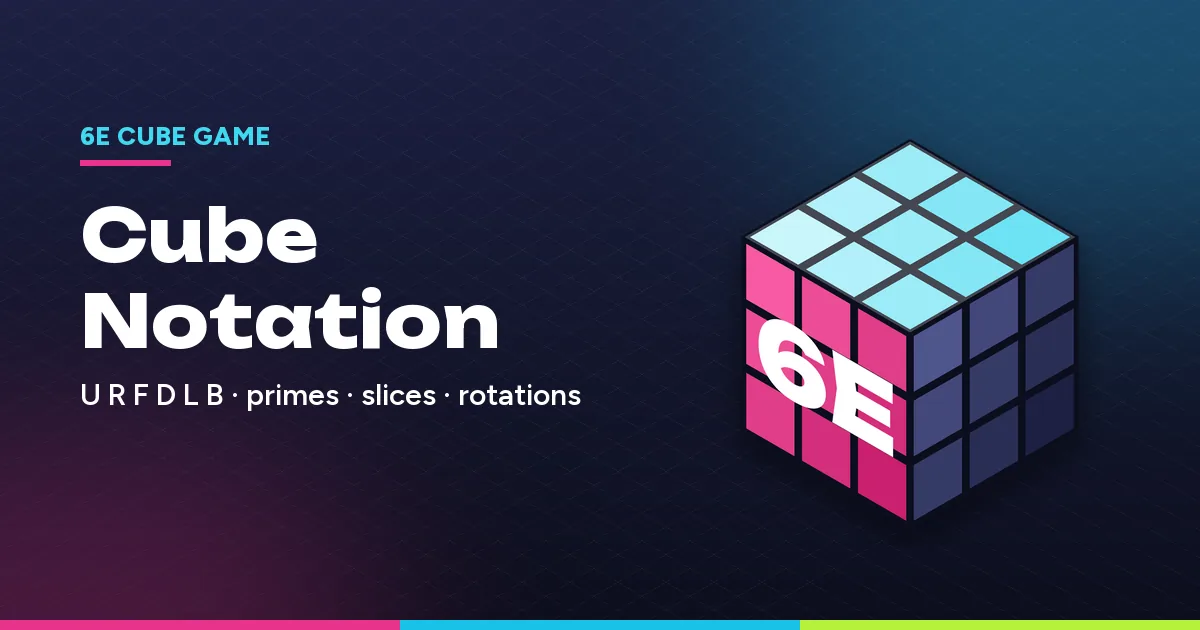
Hold the cube still and name the faces by where they are, not by colour. The names stay the same even when the colours move, which is the whole point: an algorithm written for U, R and F works from any grip.
| Letter | Name | Turns | Centre in the app |
|---|---|---|---|
U | Up | the top layer | white (in the standard scheme) |
D | Down | the bottom layer | yellow |
R | Right | the right layer | red |
L | Left | the left layer | orange |
F | Front | the layer facing you | green |
B | Back | the layer facing away | blue |
Direction and amount
A letter on its own means one quarter turn clockwise, judged as if you were looking straight at that face. Two marks modify it:
'(an apostrophe, read as “prime”) means anticlockwise:R'is the right layer turned anticlockwise from the right-hand side.2means a half turn:U2turns the top layer 180 degrees. Direction does not matter.
The tricky ones are the faces you cannot see. B is clockwise when viewed from behind, so from the front it looks anticlockwise. D is clockwise when viewed from below, so from above it looks anticlockwise. L is clockwise from the left, so from the front its top edge moves towards you. If a sequence refuses to work, one of these three is usually the culprit.
Slice moves: M, E and S
The three middle layers have their own letters. Their directions follow a neighbouring face, which is easy to forget:
| Letter | Layer | Direction |
|---|---|---|
M | Middle, between L and R | Same way as L |
E | Equator, between U and D | Same way as D |
S | Standing, between F and B | Same way as F |
M2 E2 S2 gives the chessboard pattern; the Learn tab has it as a demo.
Wide moves: two layers at once
A lower-case letter, or a capital with a w, turns a face together with the slice next to it: r or Rw is R and M together, u is U and E together, and so on. Direction follows the face. Wide moves are common in advanced last-layer algorithms because they are fast to finger.
Rotations: x, y and z
These turn the whole cube in your hands without changing the puzzle. They borrow their directions from faces:
xrotates the whole cube likeR(the front goes to the top).yrotates the whole cube likeU(the right face comes to the front).zrotates the whole cube likeF(the top goes to the right).
x', y2 and the rest follow the usual rules. The 6E Cube Game solver never needs rotations, but many algorithms begin with one.
Reading a sequence
Moves are separated by spaces and read left to right: R U R' U' is right clockwise, top clockwise, right anticlockwise, top anticlockwise. Brackets group a repeated trigger, so (R U R' U') x3 means do the four moves three times. Scrambles are written the same way; the timer on the start page shows one before every solve.
Two habits make notation second nature: keep the same grip for a whole sequence, and say each move as you do it. The algorithms page is a good place to practise, and the trainer shows any move you are unsure of.